How does a commercial security system actually protect a business?
A strong commercial security systems strategy works by layering multiple defenses—alarms, surveillance cameras, and access control—so that no single point of failure leaves a property exposed. Rather than relying on one device to do everything, each layer covers a different vulnerability, from unauthorized entry to after-hours incidents, giving business owners a more complete form of protection.
Below, we answer the questions business owners most often ask when evaluating security for their commercial property.
Why do businesses need more than a single alarm system?
A standalone alarm can alert you when a door opens unexpectedly, but it can’t tell you who opened it or what happened afterward. That’s where layered design comes in. Pairing alarms with video surveillance and access control creates overlapping protection: if one layer is bypassed, another is still working to document the event or restrict movement.
For business owners, this layered approach reduces blind spots across entrances, stockrooms, and work areas. It also means that an incident doesn’t rely on a single sensor functioning perfectly. Instead, multiple systems work together to capture what happened and limit the damage.
What role does a professional site assessment play?
Every property has different vulnerabilities depending on its layout, hours of operation, and the type of business it houses. A professional site assessment identifies these specifics before any equipment is installed. During this process, a security provider reviews entry points, existing wiring, network capability, and the physical layout of the space to determine what’s needed and what can realistically be reused.
This step matters because generic, one-size-fits-all security packages often leave gaps. A retail storefront has different risks than a warehouse or a multi-location business. Starting with a site assessment ensures that the final system actually matches the property’s real exposure points, not just a standard checklist.
How do alarms, cameras, and access control work together?
Each component plays a distinct role:
Commercial alarms monitor entrances, stockrooms, and work areas, flagging unexpected activity through door and window sensors, motion detectors, and glass-break detection.
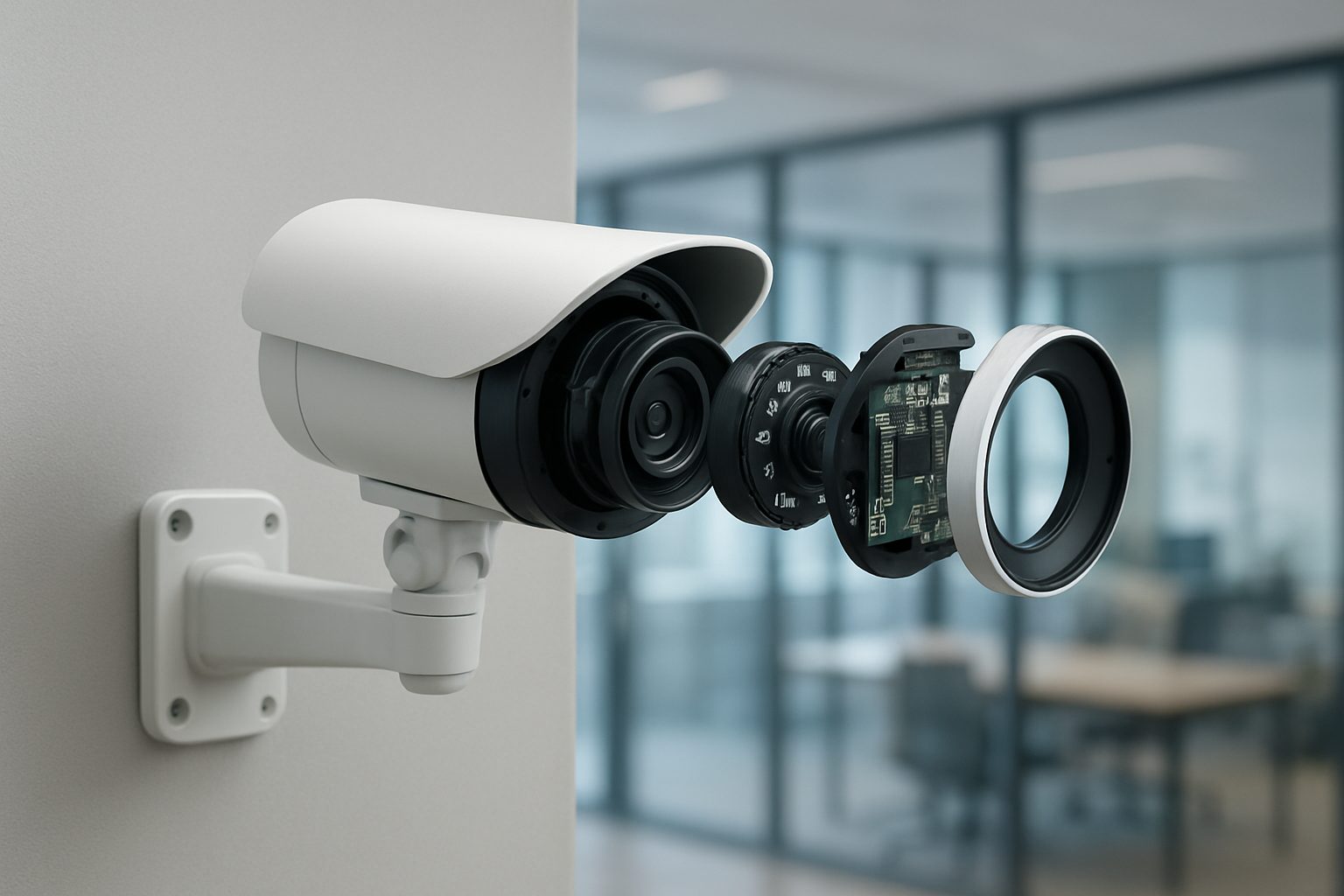
Video surveillance provides live views and recorded footage, helping business owners understand what happened during an incident rather than guessing.
Access control determines who can enter a building, which doors they can use, and when—removing the need for shared keys and reducing the risk of unauthorized entry.
When these systems are integrated, a door event can be reviewed alongside its linked camera footage, giving a business owner or manager full context instead of a fragmented view. This is the core idea behind layered design: each piece reinforces the others.
Can existing security equipment be reused instead of replaced?
In many cases, yes. Rather than assuming older equipment needs full replacement, a thorough evaluation looks at condition, compatibility, security, and supportability. If existing devices meet those standards, they can often be integrated into an upgraded system. This approach helps business owners control costs while still closing security gaps identified during the assessment.
How does security planning work for businesses with multiple locations?
Multi-location businesses face a different challenge: consistency. Without a shared management view, checking opening status, monitoring activity, and assigning staff access across several sites becomes time-consuming. A well-designed system brings these locations into one place, allowing regional managers and local staff to have the right level of access for their role, without compromising oversight at the ownership level.
Does every security system include professional monitoring?
Not automatically. Monitoring is typically scoped separately, based on the system design and how quickly a business needs a response after hours. When monitoring is included, a camera event can reach a trained operator who follows an agreed escalation plan. Alarm monitoring and video monitoring serve different purposes: alarm monitoring responds to triggered signals, while video verification adds visual context to confirm what’s happening before a response is dispatched.
Protecting people, property, and peace of mind
A commercial security system is ultimately about more than equipment. It’s about giving business owners the ability to protect their employees, safeguard their physical assets, and operate with the confidence that their property is covered from multiple angles. Layered design—built on a proper site assessment—ensures that alarms, cameras, and access control work as a connected system rather than isolated tools.
For business owners ready to understand their own property’s specific needs, the most effective starting point is a professional site assessment. This evaluation lays the groundwork for a system designed around how the business actually operates, not a generic template.
Key Points
- A strong commercial security strategy layers multiple defenses like alarms, surveillance cameras, and access control to protect a business from various vulnerabilities.
- Standalone alarm systems can identify when a door opens but do not provide details on who opened it or what happened afterward, which highlights the need for a layered system.
- Professional site assessments are crucial as they identify specific vulnerabilities unique to each property, ensuring the security system is tailored to real exposure points rather than a generic checklist.
- Integrated security components, such as alarms, cameras, and access control, provide overlapping protection and allow for a comprehensive understanding of incidents by correlating events with video footage.
- Existing security equipment can often be reused if it meets compatibility and condition standards, thereby helping businesses control costs while upgrading their security systems.
- Multi-location businesses benefit from a well-designed security system that provides consistent oversight and access management across all sites.